
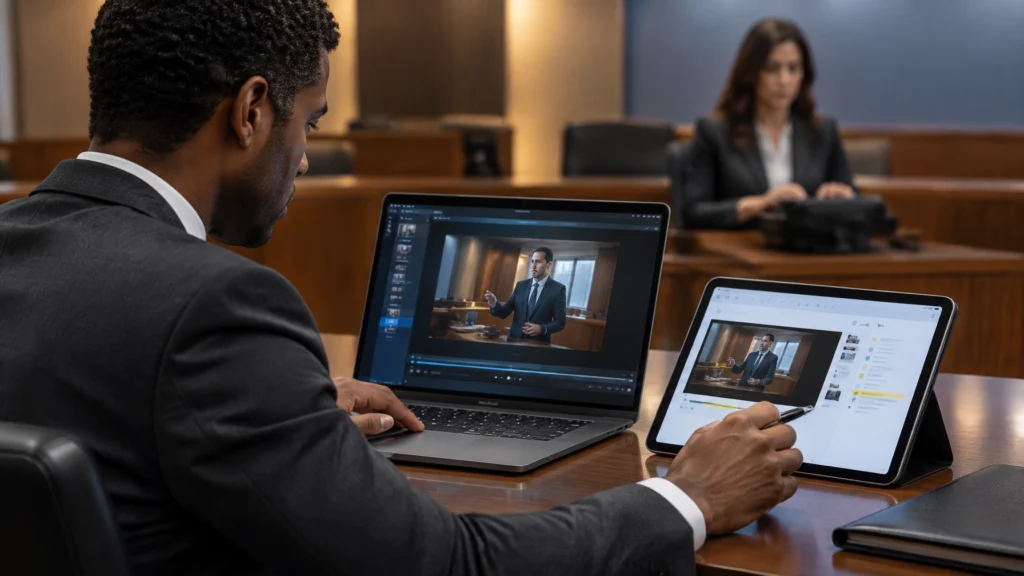
When the other side can fake anything, your proof of authenticity becomes evidence too.
That does not mean every video, image, or recording should be treated as suspect. It means litigation teams need to be prepared to show where an exhibit came from, how it was handled, and whether the version being presented is the one that was preserved.
That work starts well before trial. It starts when a recording or document enters the case, and continues through the deposition, every handoff, and the final presentation.
Treat authenticity as part of the record
At an October 15 presentation to U.S. judicial conference advisers, representatives of OpenAI and Meta warned that AI-generated videos, photos, and voices are becoming so convincing that even experts may struggle to identify fakes.
Courts are weighing possible rule changes in response. One proposal under consideration would shift the burden to the party offering a recording to show that it is probably authentic after the opposing side demonstrates that it could be fake. That is a proposal, not an adopted rule. Requirements vary by jurisdiction, so litigation teams should follow the rules and orders that apply to their case.
The figures suggest this issue may be ahead of us, not behind us. In a survey of 931 judges, only 15 reported having faced a deepfake challenge. That number does not predict when a challenge will arise, or how a court will resolve one. It does suggest that many teams may not yet have dealt with this issue firsthand.
Reported developments in November offer further reminders of the stakes: a criminal resentencing was ordered after an AI-generated victim video was shown in court, and a Brazilian court fined lawyers approximately $16,000 for hiding a prompt-injection instruction in a filing. These are distinct events, but both underscore a practical point: the reliability of digital material and the process around it can draw serious scrutiny.
For litigators, the question is not only, “Is this authentic?” It is also, “Can we explain what happened to this exhibit from the moment we received it?”
Preserve the original and annotate a copy
An exhibit may need to be highlighted, enlarged, labeled, or marked during a deposition or hearing. Those steps can help a witness and the participants focus on the relevant content. But the source itself should remain untouched.
A sound workflow keeps the original file intact and uses a separate working copy for annotations or presentation marks. That distinction matters. It helps your team explain which item is the source and which version was prepared for use in a proceeding.

In practice:
- Preserve the source in its original form.
- Create a separate copy for highlighting, stickering, or other presentation work.
- Keep the source and working copy clearly distinguishable.
- Avoid overwriting or replacing the preserved original with an annotated version.
The goal is not to create extra steps for their own sake. It is to keep the exhibit’s history clear. If questions arise later, your team should not have to reconstruct which file was used or whether the source changed during preparation.
Make the deposition a firm preservation point
A deposition is a key moment in an exhibit’s history. If an exhibit is marked during the deposition, preserve the marked exhibit as it was when the deposition concluded. Do not alter it afterward. Changing a deposition exhibit after the proceeding is complete risks changing the record.
If the team needs a different presentation version later, create a new copy for that purpose. Keep the deposition exhibit intact, and make clear that the later copy is separate from the version marked during testimony.
The certified court reporter is the keeper of the record. That role matters when the parties need to know what was marked and what occurred during the deposition. AI may assist with tasks such as searching or organizing materials, but it does not replace the reporter or determine what the official record contains.

For deposition teams, clear exhibit handling also supports a smoother proceeding. Counsel can present the intended document, manage annotations without changing the source, and keep participants focused on the testimony rather than on competing versions of a file.
Control each handoff from deposition to verdict
A reliable process does not end when the deposition closes. Exhibits may be shared with a court reporter, organized for later use, and presented again at a hearing or trial. Each handoff is an opportunity to preserve clarity, or create uncertainty.
Build a routine that makes the movement of exhibits easy to explain:
- Identify the source. Keep the original file distinct from prepared copies.
- Preserve the deposition version. Retain each exhibit as marked when the deposition concludes.
- Share deliberately. Send the intended version to the court reporter and other authorized participants.
- Archive the record. Keep the relevant exhibit versions and associated materials together for later retrieval.
- Use the correct version in court. Confirm that the presentation copy is the one your team intends to display.
Controlled sharing and consistent archiving help reduce confusion about what was sent, what was marked, and what is being shown. The objective is full provenance from deposition to verdict: a clear account of the exhibit’s path through the case.

ExhibitSuite™ is designed to help litigation teams prepare, present, annotate, share, and archive exhibits in one workflow. Teams can control when exhibits appear and manage presentation marks while preserving originals. That can make it easier to move from deposition work to courtroom presentation without relying on paper binders or a patchwork of separate tools. See ExhibitSuite™ for more information.
Use AI as an assistant, not an authenticity decision-maker
AI can support litigation work. It may help teams search, sort, or retrieve information more efficiently. But a tool’s confidence is not proof that a recording is genuine, and a generated summary is not a substitute for the underlying exhibit or testimony.
Keep accountable people responsible for decisions about what a piece of evidence is, how it is handled, and what is shared. Preserve the source. Protect the deposition record. Rely on the certified court reporter to keep the record, not on AI to replace that role.
Build the process before a challenge arises
Authenticity questions are easier to address when the team has followed a consistent process from the start. Before your next deposition, confirm that everyone handling exhibits understands:
- Which file is the preserved source. With ExhibitSuite™, all source documents are held in the Case Folder.
- How to make and identify a separate working copy.
- That deposition exhibits must not be altered after the deposition concludes.
- Who receives the exhibits and how the record will be archived.
- Which version is approved for later presentation.
The specific rules governing authentication and admissibility depend on the jurisdiction and the circumstances of the case. A disciplined exhibit workflow is not a substitute for legal analysis. It gives your team a clearer account of what it handled and how.
When the authenticity of a recording is challenged, the exhibit matters. So does the evidence of how your team preserved it.
If you'd like to see how ExhibitSuite™ can support exhibit handling from deposition through trial, request a 15-minute demo.
Frequently asked questions about exhibit authenticity
How do you prove a video is authentic in court?
By showing where the recording came from, how it was handled at every step, and that the version being presented is the one that was preserved. That means keeping the original file intact, documenting each handoff, and relying on testimony about the chain of handling rather than on a tool's confidence.
What is exhibit provenance?
Exhibit provenance is the documented history of where an exhibit came from, how it was handled, and whether the version presented is the one preserved. A clear provenance trail lets a team explain what happened to an exhibit from the moment it entered the case.
Can deepfakes be admitted as evidence?
Courts evaluate recordings under the authentication rules and orders that apply to each case. Requirements vary by jurisdiction, and proposed rule changes responding to AI-generated media are still proposals, not adopted rules. The practical safeguard is a documented, preserved original.
Should deposition exhibits be altered after the deposition concludes?
No. Exhibits marked during a deposition must be preserved exactly as marked once the deposition concludes. Changing them afterward risks changing the record. If a different presentation version is needed later, create a separate copy. Using ExhibitSuite ensures the preservation of the exact exhibit used in the deposition, hearing and trial.
Does AI decide whether evidence is authentic?
No. AI may help teams search, sort, or organize materials, but a tool's confidence is not proof. Accountable people, supported by the certified court reporter as keeper of the record, remain responsible for decisions about what the evidence is and how it is handled.
If you’d like to see how ExhibitSuite™ can support exhibit handling from deposition through trial, request a 15-minute demo.